
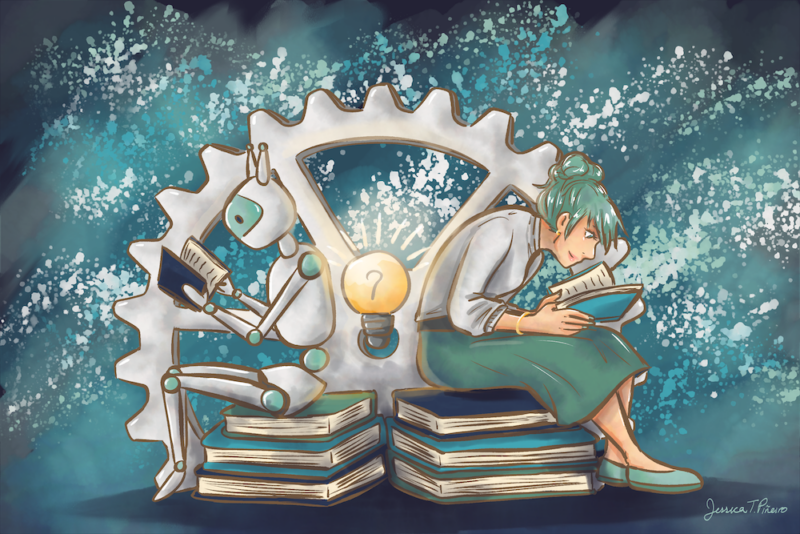
Artificial intelligence is getting better at an extraordinary pace.
The harder question may be:
Are we?
I’ve been thinking about that question a lot lately, particularly as the conversation around AI shifts from what the technology can do to what its rapid advancement means for people, jobs, and the workforce.
Recent layoffs at McClatchy brought that issue into sharper focus for me. More than 90 employees were affected across multiple publications in what was described as the company’s most severe round of layoffs in years.
To be clear, it would be inaccurate to simply say, “AI caused these layoffs.” The newspaper industry has been dealing with declining revenues, changing consumer behavior, consolidation, and other economic pressures for years.
But the story still raises an important question at a time when AI is becoming increasingly capable of performing tasks that were once exclusively human:
Are we preparing people for how quickly work is changing?
What If Humans Practiced Recursive Self-Improvement?
Howard M. Cohen recently wrote about recursive self-improvement (RSI). In AI, the concept generally refers to a system becoming capable of improving itself, with those improvements potentially enabling it to become even better at making further improvements. Howard turned the concept around and asked a fascinating question: What about us?
Can humans practice recursive self-improvement? That question stuck with me. Because perhaps that is exactly what workforce development needs to become in the age of AI.
Not one course. Not one certification. Not one degree earned early in life that is expected to carry someone through a 30- or 40-year career. But a continuous cycle of learning, applying, adapting, and learning again.
Learn → Apply → Improve → Adapt → Learn Again
If AI continues to improve, our workforce must have the opportunity to do the same.
But We Need to Know What We’re Training People For
This brings me to one of my favorite Yogi Berra quotes:
“Before we build a better mousetrap, we need to find out if there are any mice out there.”
Classic Yogi.
But there is a serious workforce-development lesson behind it. As organizations rush to provide AI training, we shouldn’t begin by asking: “What AI course should everyone take?”
We should begin by asking: “What jobs are being affected by AI, how are those jobs changing, and what AI skills do the people performing them actually need?”
An HR professional doesn’t necessarily need the same AI capabilities as a cybersecurity professional. A project manager doesn’t use AI the same way as an educator. A salesperson has different workflows and responsibilities than someone in finance. And an executive responsible for AI strategy, governance, and organizational transformation requires different competencies from an employee using AI to improve everyday productivity.
That is why I believe AI workforce development increasingly needs to be job-role based. Start with the job. Understand how AI is changing it. Identify the new competencies required. Then build the education, training, and validation around those competencies.
Job Role → AI Skills → Targeted Training → Validation/Certification → Workforce Readiness → Human Opportunity
That’s very different from simply telling everyone to “learn AI.”
Some Jobs Will Disappear
We also need to be realistic about what’s coming. There is a tendency in conversations about AI to gravitate toward one of two extremes:
- One side predicts massive job destruction.
- The other reassures everyone that AI will simply augment workers and create new opportunities.
The reality will almost certainly be more complicated. Some jobs will disappear. Others will shrink. Many will be redesigned. And entirely new roles will emerge. Workforce development cannot promise that technology won’t displace people. What it can do is give people a better chance of moving with the change instead of being left behind by it.
And that requires us to act earlier. We cannot wait until someone’s job has been eliminated to begin talking about reskilling them. By then, we’re reacting to workforce disruption rather than preparing for it.
Upskilling Before Displacement
I’ve increasingly come to think about AI workforce readiness as a progression:
Awareness → Education → Upskilling → Reskilling → Human Opportunity
- Awareness means helping people understand what’s changing.
- Education means giving them the foundational knowledge to understand AI, its capabilities, limitations, risks, and opportunities.
- Upskilling means helping people apply AI to become more effective in the jobs they already have.
- Reskilling means preparing people for substantially changed roles—or entirely different ones.
But the destination shouldn’t simply be “AI skills.” It should be human opportunity: a better job, a redesigned career, greater productivity, higher economic mobility, a new pathway into the workforce – or simply the ability to remain relevant in a profession being transformed by technology.
Employers Cannot Do This Alone
There is another part of this conversation that deserves much more attention. Employers, educators, and workforce-development organizations cannot continue operating in separate lanes. Employers understand how jobs are changing. Educators develop knowledge and foundational skills. Workforce-development organizations connect people, training, employers, and opportunity. Those worlds need to become much more closely connected.
Imagine employers routinely communicating: “Here are the jobs we need. Here is how AI is changing those jobs. Here are the competencies we need people to possess.”
Education and workforce partners could then respond: “Here is how we will prepare people for those roles.“
Now we begin connecting education, training, certifications, and credentials to actual workforce demand. That is a much stronger workforce ecosystem.
Technology Doesn’t Automatically Create Winners
Throughout my career, I’ve watched technology transform industries and occupations through: personal computers, networking, the internet, cloud computing, cybersecurity, mobile technology, and now artificial intelligence.
Each created disruption. Each created opportunity. And each required people to develop new skills.
I recently shared a post by Russell Sarder about a lesson he learned during the dot-com era: transformational technology creates enormous opportunity, but it doesn’t automatically create winners. That lesson applies perfectly to AI.
Organizations can purchase many of the same AI platforms. Competitors can access similar technologies. Employees can increasingly access the same powerful tools. The differentiator will be what organizations and their people actually do with them.
Can employees incorporate AI effectively and responsibly into their work? Can managers redesign workflows around the technology? Can leaders identify where AI creates genuine business value? And are organizations willing to invest in their people while they invest in the technology?
AI Is a Technology Conversation. But It’s Also a People Conversation.
We spend enormous amounts of time discussing how quickly artificial intelligence is improving. Maybe we should spend just as much time asking how quickly we’re prepared to improve ourselves. AI will continue learning.
Our workforce must have that same opportunity.
That means awareness before disruption. Education before displacement. Upskilling before skills become obsolete. Reskilling before someone is left without a pathway forward. And training that is connected to the jobs people actually perform – and the jobs employers will actually need.
The future of work shouldn’t simply be about creating more capable machines. It should also be about creating more capable, adaptable, and opportunity-ready people. Because ultimately, the most important question isn’t whether AI will be ready for the future of work.
It’s whether we will be.
One thing that has remained consistent since the earliest days of personal computing is that everything begins with practical application. Your right-on-target interpretation is that, more often than not, it will support something someone is doing on the job.
Regarding your question about whether or not humans are capable of recursive self-improvement. Our continued existence proves we are. And I’ve never believed that some are just better at it than others. Instead, what I believe is that some are more committed to it, more passionate about, more driven by it.
We call them “lifelong learners.”
One of the greatest things I’ve found by using AI is that every time I do something with it, I learn things. It finds facts and issues that would take me much longer to find. It puts together the thoughts of many writers, theologists, educators, and others to create interesting ideas. Most important for me, they ask me provocative questions that require deep thought from me. These promote great progress in my work.
So, as much as I know we humans are capable of recursive self-improvement, we also benefit from AI input that helps us improve as well.
I’ve emphasized in recent articles that AI is a tool meant for us to use to improve our work, and enable new work. Your article supports that very well.
Angel, thank you for this. Your point that AI workforce readiness must start with the job rather than the technology is the one I see organizations miss most often. Tool training is easy to buy and easy to measure, but it ages quickly. Skills tied to how work is actually changing hold their value.
I also appreciated your distinction between upskilling and reskilling, and the reminder that a workforce conversation has to include the people whose roles are shifting, not just the people building the tools. In my advisory work with growth-stage leaders, the organizations that get ahead are the ones that treat this as a strategic investment, with clear skills targets and credentials that signal real capability, rather than a one-time training event.
The urgency in your closing is right: the question isn’t whether AI will improve, it’s whether we’ll be deliberate about the people alongside it. Grateful for your leadership on this.